The short answer
Both designs are online double conversion. The inverter feeds the load all the time and the battery sits behind it on the DC bus, so a mains failure causes no break at the output. The difference is what sits between the inverter and the load.
- Transformer-based (low-frequency): the inverter output passes through a heavy 50/60 Hz transformer. You get galvanic isolation and better tolerance of inrush and step loads. You pay in size, weight and efficiency.
- Transformerless (high-frequency): the power stages switch at high frequency and the inverter feeds the load directly. The unit is smaller, lighter and more efficient, with cleaner input current. There is no built-in isolation.
A quick rule of thumb:
| Situation | Usually the better fit |
|---|---|
| Rotating machines, a dirty supply or an isolation requirement | Transformer-based |
| Servers, network gear, PLC cabinets and instruments on a usable grid | High-frequency |
| A load that will grow, or must stay on line while the UPS is serviced | Modular (high-frequency modules) |
The same designs go by other names. Transformer-based units are also called low-frequency, line-frequency or “online UPS with isolation transformer”. Transformerless units are also called high-frequency or transformer-free.
How a transformer-based UPS works
Power takes four steps from mains to load:
- Rectifier – converts mains to DC. Industrial designs often use a thyristor (SCR) bridge.
- DC bus – charges the battery and feeds the inverter.
- Inverter – builds a sine wave.
- Output transformer – brings it to the output voltage and separates the load electrically from the input.
That last stage is the point of the design. A transformer working at line frequency is large: copper windings on a steel core sized for 50 or 60 Hz. It is also forgiving. It absorbs the current spike when a motor, pump or compressor starts, and it helps deliver enough current into a downstream fault for the right breaker to trip.
What the transformer gives you
- Galvanic isolation. There is no direct conductive path from mains to load. The secondary can be bonded to earth to create a new neutral, which helps on sites with poor earthing or a floating neutral.
- Inrush and fault current. Motor starts, transformer energising and capacitor banks are easier on a design with a transformer and a heavier power stage.
- Tolerance of awkward loads. Low power factor and unbalanced phases are handled with more margin.
What it costs
- Weight and floor space. For the same rating, a transformer-based cabinet is noticeably taller and heavier. Check floor loading, lifting access and freight.
- Efficiency. Transformer losses are present whenever the unit runs, so online-mode efficiency is lower than a high-frequency unit of the same rating.
- Input current quality. A simple thyristor rectifier draws distorted current with a lower input power factor. On generator-fed sites, ask for an input harmonic filter or a 12-pulse rectifier on larger frames.
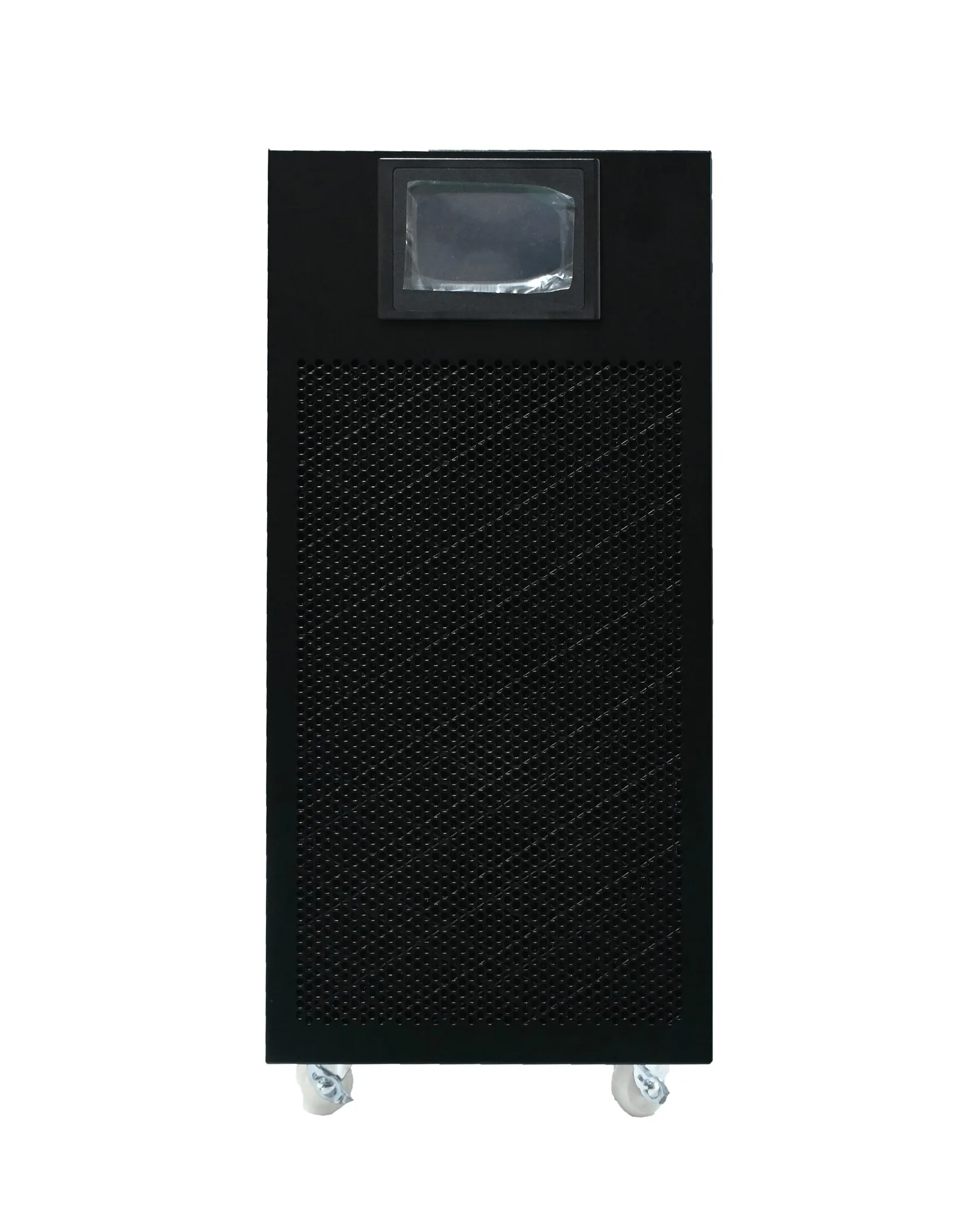
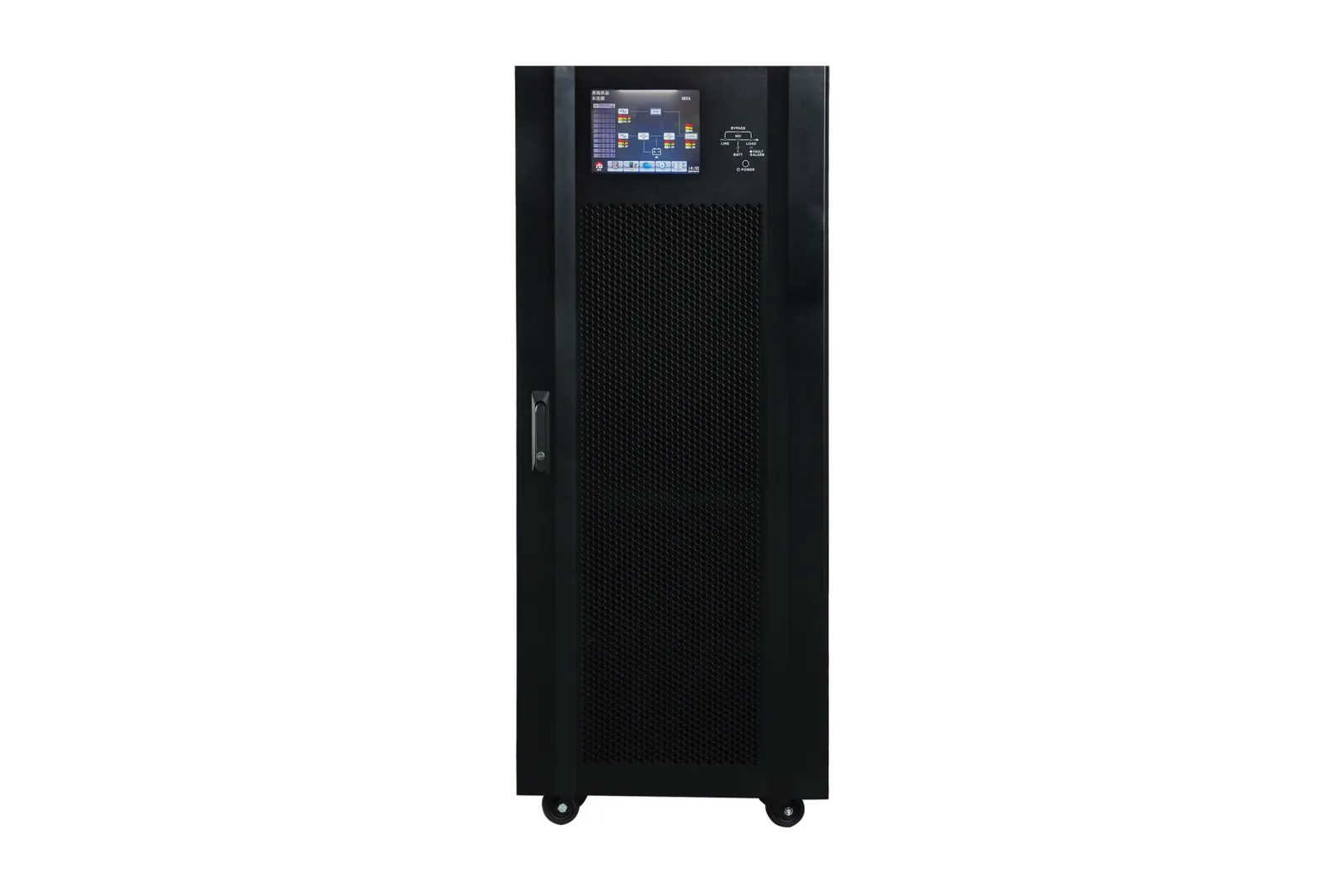
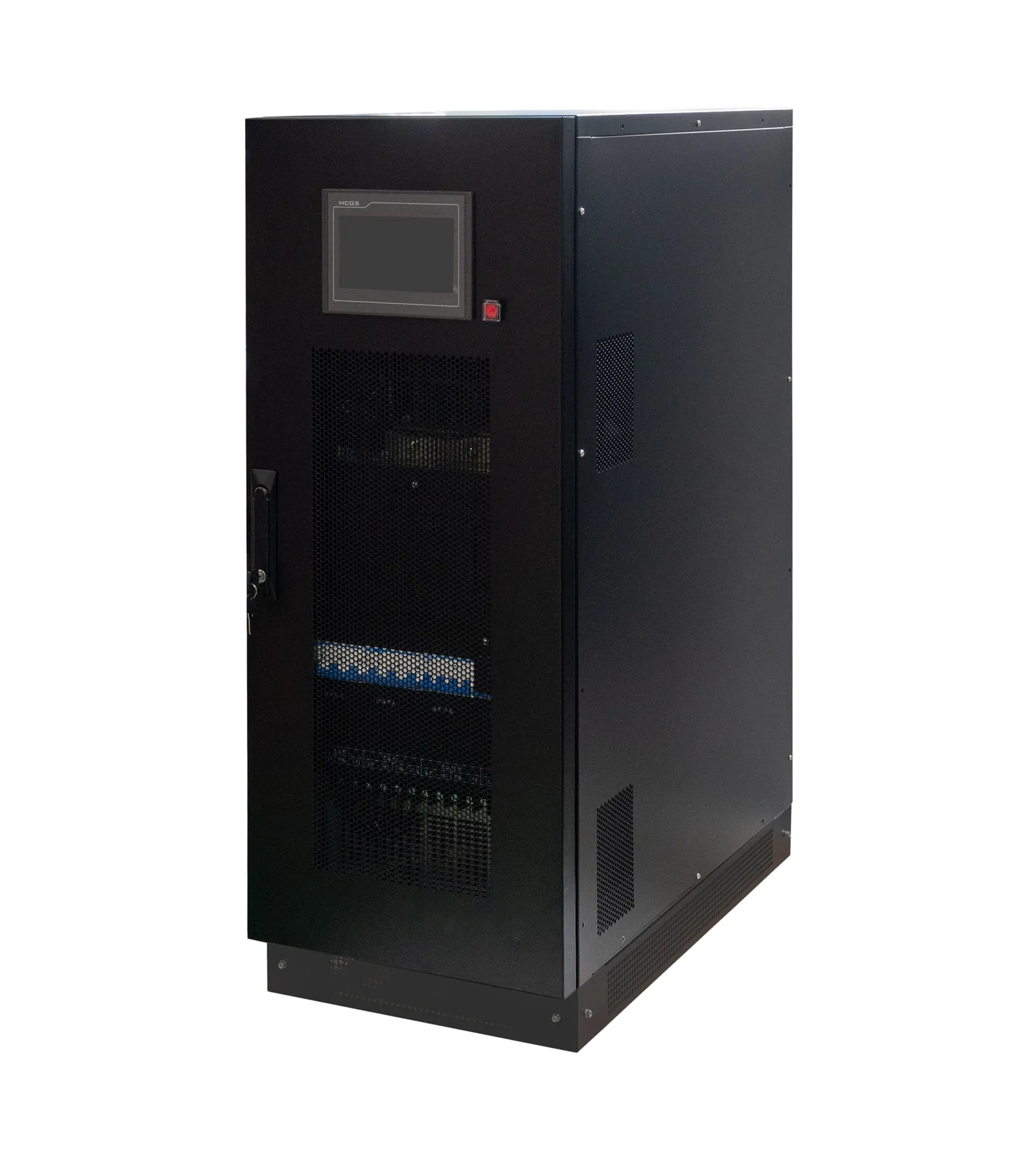
Our transformer-based industrial range (X11, X31 and X33) has an output isolation transformer and covers single-phase 1–40 kVA, three-phase in / single-phase out 6–120 kVA, and three-phase 10–800 kVA. The three-phase models have an output power factor of 0.8, so a 100 kVA unit delivers 80 kW.
How a transformerless (high-frequency) UPS works
The rectifier is an IGBT stage with active power-factor correction, so it draws current that follows the voltage waveform. Input power factor is close to unity and current distortion is low, which means smaller cables, breakers and generator for the same load.
The inverter switches at high frequency and its output goes to the load without a 50/60 Hz transformer. The battery usually connects to the DC bus through a DC/DC converter, which decouples the battery string voltage from the bus.
Removing the transformer changes the physical product more than the electrical one. The same rating fits a smaller tower, and at lower ratings a 19-inch rack frame.
What you gain
- Size and weight. Easier to lift, place on a raised floor or fit into a rack.
- Efficiency. Higher online-mode efficiency, and on our three-phase high-frequency range an ECO mode of at least 98.5%. Every lost point is heat the room cooling must remove.
- Clean input. Near-unity input power factor and low current distortion.
- Full kW rating. Our single-phase high-frequency range has output power factor 1, so a 10 kVA unit delivers 10 kW.
What you give up
- No galvanic isolation. If the specification asks for it, or site earthing is poor, add an isolation transformer on the output or choose a transformer-based unit.
- Inrush handled electronically. A large starting current is met by the inverter’s current limit and, beyond that, by the static bypass, which puts the load on raw mains for that moment.
- Overload tables look similar. Datasheet overload ratings of both families are often close. What the table does not show is behaviour in the first instants of a motor start, which is where the transformer helps.
Our high-frequency online range (H11, H31 and H33) covers 1–600 kVA: single-phase 1–10 kVA, three-phase in / single-phase out 10–30 kVA and three-phase 10–600 kVA, with 0 ms mains-to-battery transfer.
Side-by-side comparison
| Transformer-based | High-frequency | |
|---|---|---|
| Size and weight | Larger, heavier | Compact; tower or rack |
| Efficiency, online mode | Lower | Higher; ECO mode available |
| Input power factor | Lower; may need a filter | Near unity |
| Input current distortion | Higher without a filter | Low |
| Output power factor | Typically 0.8 | Up to 1 |
| Inrush, motor loads | Handles starting current better | Relies on current limit and bypass |
| Galvanic isolation | Yes, output transformer | Not built in; add a transformer |
| Mains-to-battery transfer | 0 ms | 0 ms |
| Price and freight | Usually higher: more copper and steel | Usually lower for the same rating |
| Best fit | Factories, motors and drives, oil and gas, substations, weak or generator-fed grids | Server and network rooms, telecom, control cabinets, labs, offices |
On compliance: our high-frequency online range is CE tested to EN IEC 62040-1 (LVD) and EMC. The transformer-based range is not covered by that CE file, so for projects that require CE marking, discuss the requirement with us before choosing.
How to choose by load and grid
Start with the load, then check the supply, then the site. If two or more of the first list are true, look at transformer-based. If none are, high-frequency is usually the better buy.
Lean towards transformer-based if
- The load includes motors, pumps, compressors, drives or transformers with high starting current.
- The supply is weak, generator-fed, or has frequent sags, swells and spikes.
- Site earthing is poor, or the load needs a stable, low neutral-to-earth voltage.
- The specification calls for galvanic isolation between mains and load.
- The load power factor is low or the phases are badly unbalanced.
- The unit goes into a plant room where weight and floor space are not the limit.
Lean towards high-frequency if
- The load is servers, network, telecom, PLCs, instruments or other electronic power supplies.
- The grid is usable, or the generator was sized for a near-unity power factor load.
- Space, floor loading or freight weight is limited, or the unit must fit a 19-inch rack.
- The unit runs around the clock and running cost matters.
- Isolation, if needed, can be added with a separate transformer.
Two quick examples
- Packaging line with an air compressor, conveyor drives and two PLC cabinets, backed by a diesel generator: transformer-based, sized for the compressor start.
- Office server room with servers, switches and storage on a stable city supply, on an upper floor: high-frequency three-phase, or rack units.
When neither is the answer: modular
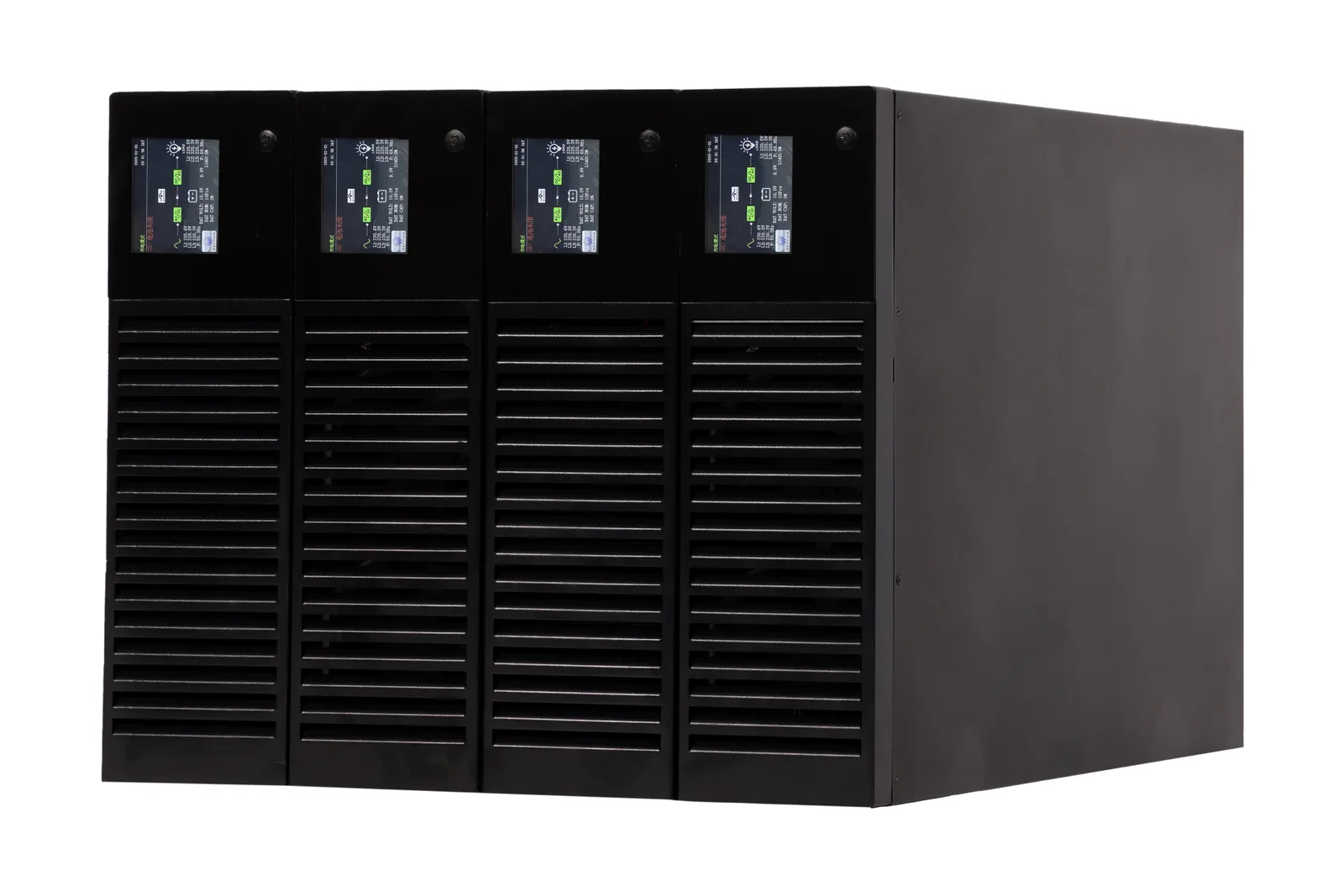
A modular UPS is a cabinet of hot-swappable power modules sharing one frame, bypass and battery. Each module is high-frequency, so the isolation remarks above apply. What changes is how you buy capacity and resilience. Our M33 uses 20, 30 or 50 kVA modules in systems from 20 to 600 kVA with N+X redundancy. It suits loads that grow in steps and sites that cannot take a bypass transfer for service. Stay with a transformer-based unit when the load is mostly motors or isolation is required and there is no room for a separate transformer.
Five inputs to send before asking for a quote
- Load in kVA and kW, now and in three years.
- Largest motor or inrush load, with its starting method.
- Input voltage, phases and frequency, and whether a generator feeds the site.
- Earthing system and any isolation requirement.
- Backup time and installation space, including floor loading for battery cabinets.
Related products
- Industrial transformer-based UPS and the three-phase industrial range
- Three-phase online UPS, high-frequency
- Single-phase online UPS
- Modular online UPS
Not sure which topology fits? Send us the load list and grid details and an engineer will recommend a topology, rating and battery setup.